
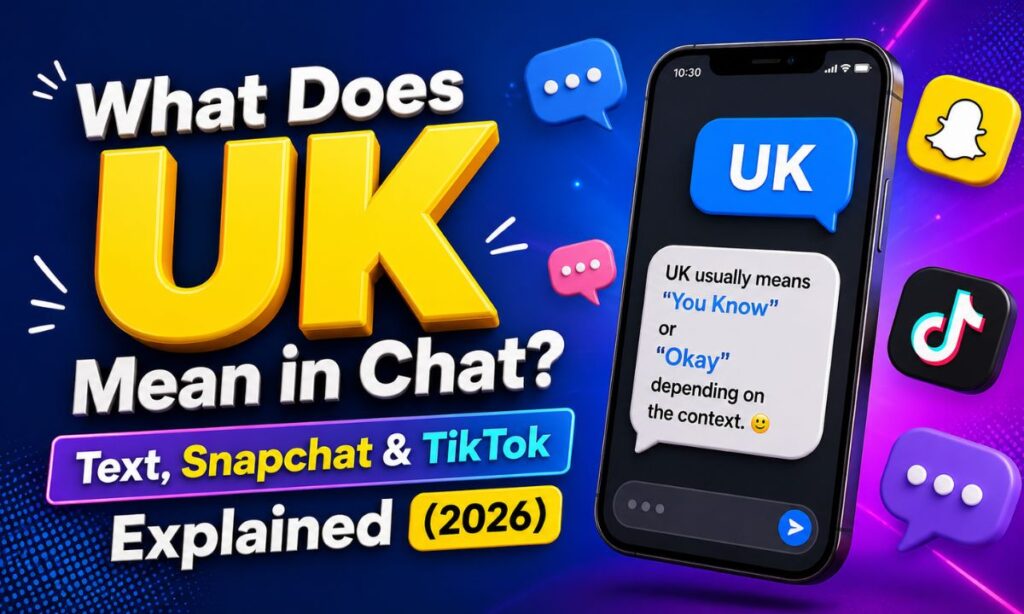

UK mean in chat, in most cases, is short for “you know” — a casual filler people use when they assume you already understand what they’re talking about. You’re texting a friend, they reply with a single line, and it just says “uk.” No context, no punctuation, no explanation — just those two letters left for you to decode.
This isn’t the same “UK” that shows up in geography class. In texting, Snapchat, TikTok, and Instagram DMs, UK is almost always lowercase slang, not a reference to the United Kingdom. Knowing the difference matters, because reading it the wrong way can completely change how you understand a message.
This guide breaks down every common meaning of UK in chat, how it’s used across different apps, whether it’s considered slang or an acronym, and how to reply when someone sends it to you.
What Does UK Mean in Chat?
In chat and texting, UK almost always means “you know.” People use it as a quick, low-effort way to reference something they assume the other person already understands. It’s the digital version of trailing off mid-sentence with “you know…?”
Context is everything here. If someone texts “uk what i mean,” they’re saying “you know what I mean” — looking for agreement or shared understanding. It’s rarely used to talk about the country; capitalization patterns and sentence context usually make the difference clear.
UK Meaning in Text Messages
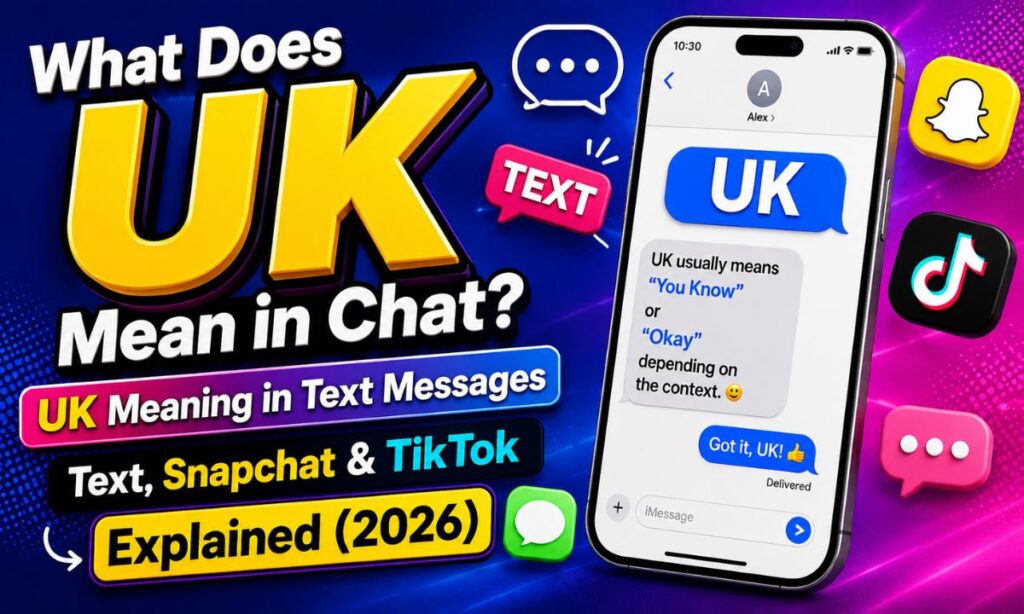
In regular SMS or iMessage conversations, UK works as a shorthand filler word rather than a formal abbreviation. It shows up mid-sentence far more often than as a standalone reply, which is one clue that it’s not referring to the country.
A typical text might read, “that party was uk, kind of awkward tbh.” Here, UK softens the sentence and implies the reader already has some shared context. It saves keystrokes without losing the casual, conversational tone that texting relies on.
Is UK a Slang Term?
Yes, UK functions as internet slang when it’s used to mean “you know.” It belongs to a family of texting abbreviations — like idk, tbh, and fr — that exist purely to speed up casual typing.
It didn’t originate from a dictionary definition; it developed organically through fast-paced messaging where every extra keystroke counts. Because it’s informal, it’s best kept to casual conversations rather than professional or academic writing.
What Does UK Mean on Snapchat?
On Snapchat, UK is typically used the same way as in text messages — as a stand-in for “you know.” It shows up often in captions or chat replies where space is limited and tone is casual by default.
Snapchat’s fast, disappearing-message culture makes shorthand like UK especially common. A caption like “this fit uk 🔥” is saying “you know” this outfit is good, relying on the reader to fill in the rest.
UK Meaning on Instagram
On Instagram, UK shows up most in comments, DMs, and captions, again usually meaning “you know.” It’s common in reply threads where someone is agreeing with or referencing an earlier comment without repeating it in full.
Occasionally, UK on Instagram bios or location tags does mean the United Kingdom — for example, someone listing “UK 🇬🇧” as their country. The all-caps, standalone placement in a bio is the giveaway that it’s the country, not the slang term.
UK Meaning on TikTok
On TikTok, UK appears constantly in comment sections, usually as slang for “you know.” Comments like “uk it’s giving main character energy” use UK to add a casual, conversational rhythm to the sentence.
TikTok also has a second, unrelated use: creators often tag videos or captions with “UK” to indicate the content is relevant to the United Kingdom specifically — UK news, UK slang, or UK-based trends. Reading the surrounding words tells you which meaning applies.
UK Meaning on WhatsApp
WhatsApp conversations use UK largely the same way as SMS texting — as shorthand for “you know,” especially in group chats where messages move quickly. It’s common among younger users chatting informally with friends or classmates.
Because WhatsApp is also widely used for international communication, UK is more likely to mean the country when it appears in formal or logistical messages — like discussing travel plans, addresses, or shipping. The context of the conversation, not the platform, decides the meaning.
Is UK an Acronym, Abbreviation, or Slang?
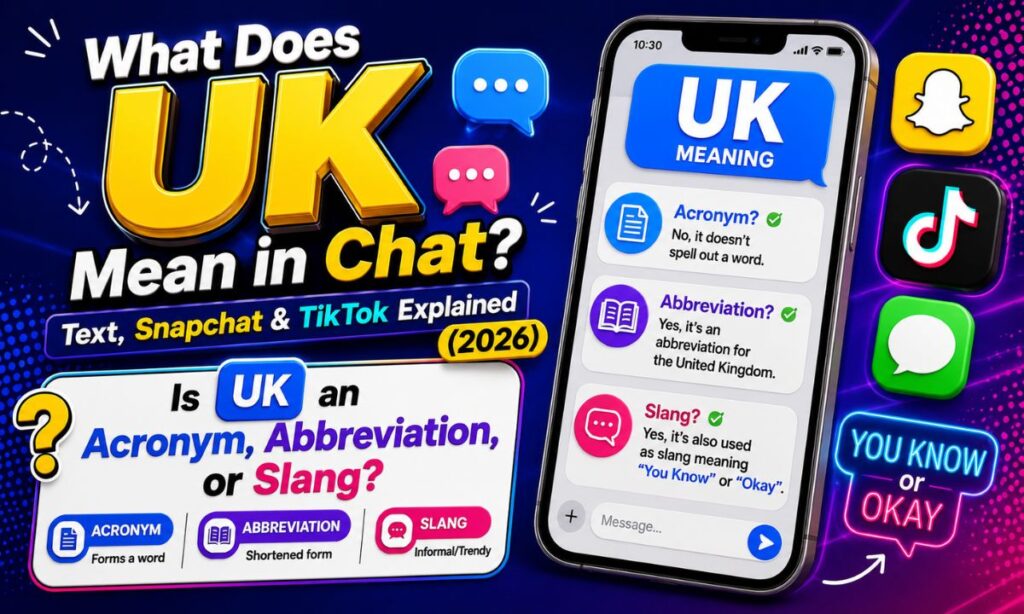
Technically, UK is an abbreviation when referring to the United Kingdom, since each letter stands for part of an actual name. In chat culture, though, UK functions as slang — a shortened, informal stand-in for the phrase “you know.”
It isn’t a true acronym in either case, since acronyms are pronounced as words (like NASA), and UK is spoken letter by letter or read silently within a sentence. Understanding this distinction helps explain why the same two letters carry such different meanings depending on where you see them.
Why Do People Search “UK Meaning in Chat”?
Most people search this phrase because they received a message with “uk” in it and the context wasn’t obvious — maybe from a new group chat, a stranger’s comment, or an unfamiliar app. It’s a natural response to encountering unclear digital slang.
Younger texting culture moves fast, and abbreviations spread before their meanings are widely known outside certain groups. Parents, teachers, and people newer to texting slang often search this term specifically to keep up with how kids and teens communicate.
Other Possible Meanings of UK
Outside of “you know,” UK most commonly refers to the United Kingdom, the sovereign country made up of England, Scotland, Wales, and Northern Ireland. This meaning shows up in formal writing, news, addresses, and geography-related conversations.
Less commonly, UK can appear as a username fragment, a gaming tag, or shorthand in niche online communities with their own specific meaning. When in doubt, the safest approach is to ask the sender directly what they meant.
Tone and Context Variations
The tone of a message featuring UK depends heavily on what surrounds it. In a casual, joking conversation, “uk” reads as light and relaxed — almost like a verbal shrug that keeps the exchange easy going.
In a more serious or emotional conversation, “uk” can carry weight, implying “you know how I feel” or “you understand without me having to explain.” The same two letters can feel breezy or heavy depending entirely on the emotional context of the chat.
Real Chat Examples Using UK
Here are a few real-style examples showing how UK typically appears in casual conversation:
- “i’m not mad, uk, just tired”
- “uk how it is with him lol”
- “this song hits different uk”
Each example uses UK as a stand-in for “you know,” and none of them are referring to the country. Reading the full sentence, rather than the abbreviation alone, is the fastest way to correctly interpret the meaning.
Grammar and Language Role of UK
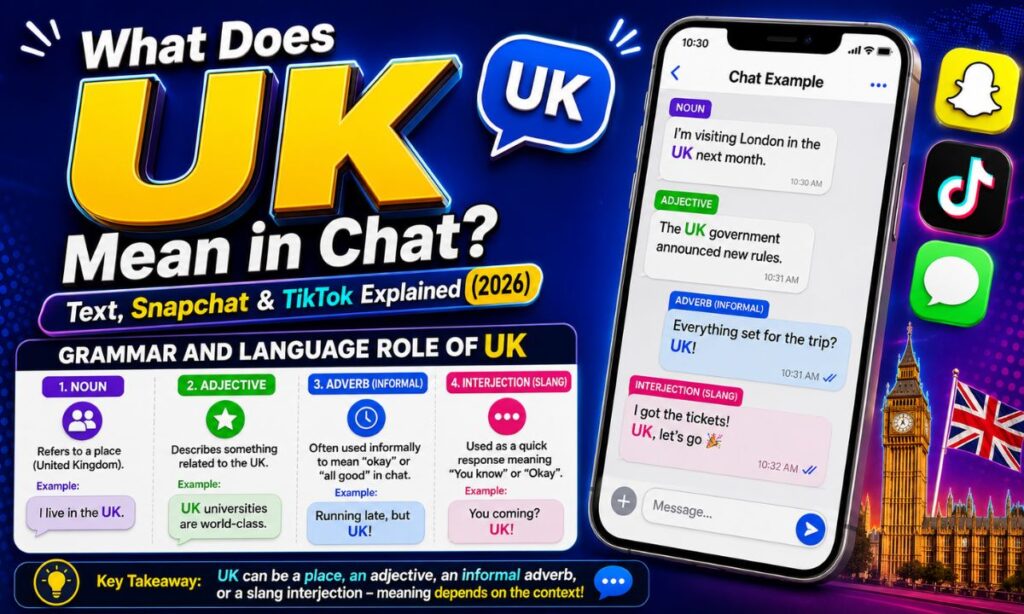
Grammatically, UK as slang functions as a filler phrase rather than a true part of speech. It doesn’t act as a noun, verb, or adjective on its own — it stands in for the full phrase “you know,” which itself works as a conversational hedge.
As an abbreviation for the country, UK functions as a proper noun and follows standard capitalization and grammar rules. This is another reliable clue: proper noun usage tends to appear in more formal, structured sentences, while the slang version fits naturally into casual, unpunctuated texting.
How to Reply When Someone Says UK
If someone texts you “uk” and you understand the reference, a simple “yeah, for real” or “same” keeps the conversation flowing naturally. Matching their casual tone shows you’re on the same page without overexplaining.
If you genuinely don’t follow what they mean, it’s completely fine to ask — something like “uk what?” or “wait, what do you mean?” works well. Most people appreciate the clarification rather than being left to guess.
Comparison Table
| Term | Common Meaning | Typical Usage |
| UK (lowercase, mid-sentence) | “You know” | Casual texting, Snapchat, TikTok comments |
| UK (capitalized, standalone) | United Kingdom | Bios, addresses, formal writing, news |
| IDK | “I don’t know” | Uncertainty or lack of information |
| IK | “I know” | Agreement with a previous statement |
| TBH | “To be honest” | Adding honesty or opinion to a statement |
This table highlights why context and formatting matter more than the letters themselves. UK shares space with several similar-looking abbreviations, and mixing them up is one of the most common sources of confusion in group chats.
Who Uses the Term UK?
UK as slang is most commonly used by teenagers and young adults who grew up texting and using social media as a primary form of communication. It’s especially common on platforms with fast-scrolling comment sections, like TikTok and Snapchat.
That said, the term has spread widely enough that people of many ages now recognize and use it casually, especially in group chats with younger family members or coworkers. Its casual nature keeps it mostly confined to informal digital spaces rather than spoken conversation.
Origin and Internet Culture Insight
Like many texting abbreviations, “uk” for “you know” likely emerged from the broader shift toward shorthand communication driven by character limits, typing speed, and mobile keyboards. [External source: citation needed for earliest documented usage of “uk” as texting slang]
It follows the same pattern as terms like “idk,” “smh,” and “fr,” all of which trimmed common phrases down to their fastest typed form. As texting and social media commenting became faster-paced, these shortcuts became second nature rather than a conscious choice.
Is UK Rude?
On its own, UK is not rude — it’s a neutral filler phrase used constantly in casual, friendly conversation. Most people who use it aren’t trying to sound dismissive or short with the person they’re talking to.
Tone still matters, though. If UK is used in response to a serious question, or paired with a dismissive follow-up, it can come across as short or uninterested. As with most texting slang, the surrounding message decides whether it reads as casual or curt.
Is UK a Bad Word?
No, UK is not a bad word or offensive term in either of its common meanings — the country abbreviation or the “you know” slang. It doesn’t carry profanity, hostility, or inappropriate connotations in standard usage.
The only situation where confusion might arise is if UK is mistaken for a completely different, unrelated abbreviation used in a specific subculture or private group chat. In those rare cases, asking for clarification is always the simplest solution.
Should You Use UK in School or Office?
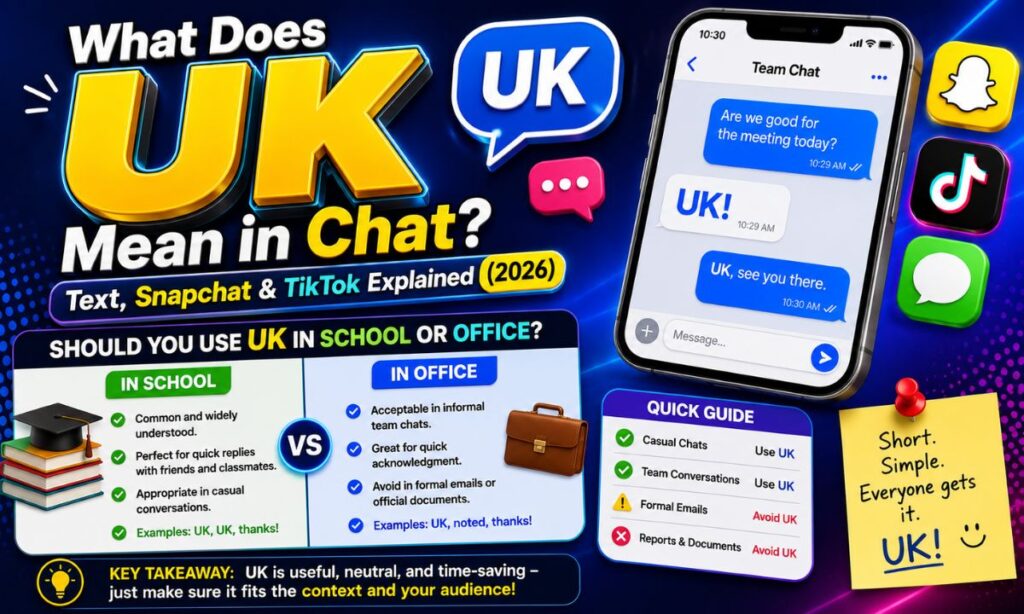
In school assignments, professional emails, or workplace messaging, it’s best to avoid using UK as slang for “you know.” Formal writing calls for complete phrases, and shorthand like this can come across as unpolished or overly casual.
Using UK to refer to the United Kingdom, however, is completely appropriate in academic or professional contexts, since it functions as a standard abbreviation there. The rule of thumb: save the slang version for texting friends, and stick to full phrases in anything formal.
Experience-Based Insight
People who spend a lot of time in group chats and comment sections tend to pick up on UK’s meaning quickly, simply through repeated exposure. It’s one of those terms that becomes intuitive after seeing it a handful of times in context.
For newcomers to texting slang — including parents monitoring their kids’ messages or professionals adjusting to younger coworkers’ communication style — it can take a little longer to feel natural. Recognizing the pattern (short, lowercase, mid-sentence) is usually enough to read it correctly going forward.
UK meaning in chat from a girl
When a girl texts “uk” in a conversation, it typically carries the same “you know” meaning as it does for anyone else — there’s no gender-specific definition attached to the term. It often shows up when expressing emotions or shared understanding, like “i just feel uk, off today.”
In flirtier or more personal conversations, “uk” can sometimes imply an unspoken feeling — “uk how i feel about you” leaves room for the other person to read between the lines. The vagueness is often intentional, used to hint at something without stating it outright.
Uk meaning in chat from a guy
When a guy sends “uk” in chat, it carries the same core meaning — “you know” — without any different rules based on who’s sending it. It’s commonly used casually, especially in response to something that doesn’t need a long explanation.
In more personal exchanges, guys may use “uk” similarly to soften an emotional statement, like “i miss hanging out uk,” easing into a feeling without over-explaining it. As with any texting slang, tone depends far more on the relationship and context than on who’s typing it.
UK means which country
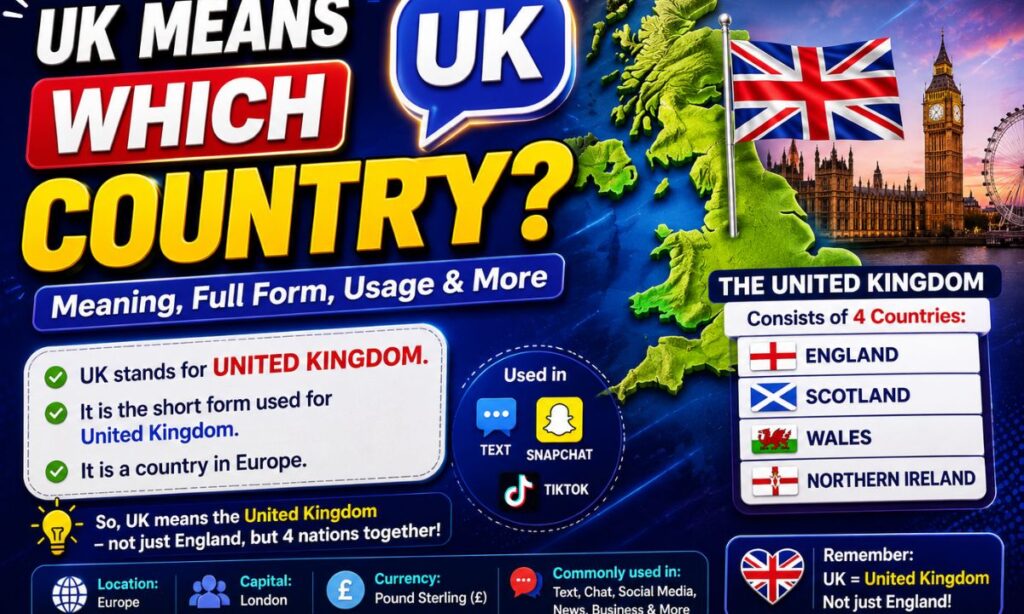
UK stands for the United Kingdom, officially known as the United Kingdom of Great Britain and Northern Ireland. [External source: citation needed for official country name and formation date] It’s made up of four constituent nations: England, Scotland, Wales, and Northern Ireland.
This meaning of UK is the one taught in geography and used in official, formal, and international contexts — passports, addresses, news reporting, and government documents. It’s completely unrelated to the casual “you know” slang, and the two are almost never confused once you know what to look for in the sentence.
[Image: A simple side-by-side graphic showing “uk” used in a casual text bubble vs. “UK” on a map/flag, to visually reinforce the two meanings]
[Internal link: related slang terms guide — “what does idk mean in chat”]
Frequently Asked Questions
Text messages mein “UK” ka kya matlab hota hai?
Text messages mein “UK” aksar “you know” ka short form hota hai. Yeh casual tor par tab use hota hai jab sender samajhta hai ke doosra insaan pehle se hi us baat ko samajh raha hai.
Kya “UK” likhna bad-tameezi samjha jata hai?
Nahi, “UK” apne aap mein bad-tameezi nahi hai. Yeh sirf tab thoda rude lag sakta hai agar kisi serious sawal ka jawab bohat casual andaz mein diya jaye.
Snapchat par “UK” ka istemal kis maqsad ke liye hota hai?
Snapchat par “UK” zyada tar “you know” ke matlab mein use hota hai, khas tor par captions aur replies mein. Yeh fast aur casual conversation style ke saath match karta hai.
Kya “UK” aur “IDK” ek jaisa matlab rakhte hain?
Nahi, dono ka matlab bilkul mukhtalif hai. “UK” ka matlab “you know” hai jabke “IDK” ka matlab “I don’t know” hota hai — yani ulta matlab.
Kya bade log bhi “UK” use kar sakte hain?
Ji haan, koi bhi age group ka insaan “UK” use kar sakta hai, lekin yeh term zyada tar teenagers aur young adults mein common hai. Casual texting mein iska use age ki koi qaid nahi rakhta.
Agar koi aapko “UK” likhe to aap kaise jawab dete hain?
Agar aapko matlab samajh aa jaye to “yeah, totally” jaisa casual jawab dena kaafi hota hai. Agar samajh na aaye to seedha pooch lena best hota hai, jaise “uk what?”
Kya “UK” internet ki ek aam slang hai?
Ji haan, “UK” internet aur texting culture mein ek common slang term ban chuka hai. Yeh idk, tbh, aur fr jaisi shorthand abbreviations ki family mein aata hai.
Log chat mein “UK” ka matlab kyun search karte hain?
Log yeh term search karte hain kyunke unhe koi message mila hota hai jisme “uk” ka matlab clear nahi hota. Yeh khas tor par un logon ke sath hota hai jo texting slang se zyada familiar nahi hote.
Conclusion
At its core, the answer to “what does UK mean in chat” comes down to two very different possibilities: a casual stand-in for “you know,” or a reference to the United Kingdom itself. Ninety percent of the time in texting, Snapchat, TikTok, and Instagram comments, it’s the slang version — quick, lowercase, and buried mid-sentence.
The safest way to read it correctly is simple: look at the sentence around it. Formal, capitalized, standalone usage almost always points to the country, while casual, lowercase, mid-message usage points to “you know.” Once you spot that pattern, you’ll never have to second-guess a text with “uk” in it again.