

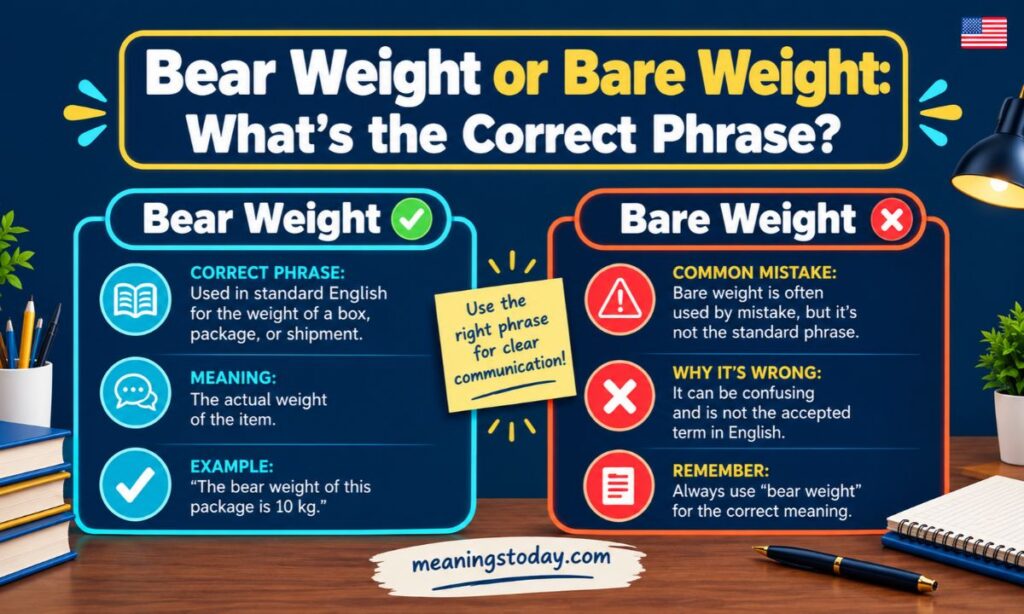

Bear Weight vs Bare Weight has one right answer: “bear weight.” “Bear” means to carry or support a load. “Bare” means uncovered or empty, so it does not fit. If something holds up a load, write “bear.”
Both words sound the same, so people mix them up in writing. This guide gives you the meaning, easy examples, medical use and simple tricks. You will pick the right word every time.
Quick Answer
Here is the fast answer to Bear Weight vs Bare Weight. Follow these steps.
- Look at your sentence.
- Ask: is something carrying or holding a load?
- If yes, write “bear weight.”
- If something is uncovered or empty, write “bare.”
- ✅ Correct: bear weight
- ❌ Wrong: bare weight
Example: “The shelf can bear weight up to 50 pounds.” The shelf holds a load, so “bear” is right.
Bare Weight vs Bear Weight Meaning
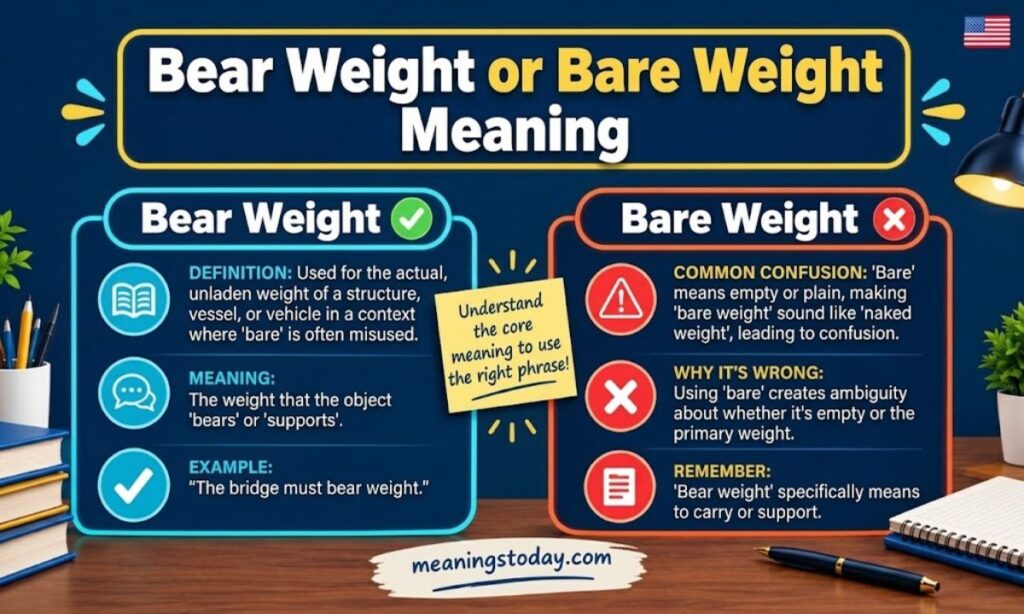
“Bear weight” means to hold up or carry a load. The load can be physical or emotional. “Bare weight” is a spelling mistake in this phrase.
Follow these steps:
- Check the meaning of each word.
- Find the word’s job in your sentence.
- Pick the one that fits.
Bear
“Bear” is a verb here. It means to carry, hold up or put up with something.
- Physical load: A bridge bears the weight of trucks.
- Emotional load: She bears the weight of a tough choice.
- Other uses: bear a cost, bear fruit.
Example: “This beam can bear weight from the roof.”
Bare
“Bare” is mostly an adjective. It means naked, empty or just enough. As a verb, it means to uncover.
- Bare feet
- Bare walls
- The bare minimum
Example: “The kids ran on the beach with bare feet.”
Pronunciation: both words sound the same, /bɛr/. Only the spelling and meaning differ.
Key Differences Between the Words
The gap in Bear Weight vs Bare Weight is tiny in sound but big in meaning. Spot it in three steps.
- Say the meaning in plain words: “carry” or “uncovered”?
- Check the word type.
- Pick the word that matches.
- Meaning: “bear” is to carry. “Bare” is to show or be empty.
- Word type: “bear” is a verb or noun. “Bare” is an adjective or verb.
- Animal: “bear” is also an animal. “Bare” is not.
- In this phrase: only “bear” is correct.
Example: “The floor can bear weight.” It holds a load. “The floor is bare.” It has no cover.
Comparison Table
This table shows Bear Weight vs Bare Weight at a glance. Find your idea in the left column, read across, then copy the sample sentence style.
| Feature | Bear | Bare |
| Sound | Same | Same |
| Meaning | Carry, support, endure | Naked, uncovered, empty |
| Word type | Verb, noun | Adjective, verb |
| Right for “weight”? | ✅ Yes | ❌ No |
| Example | The beam can bear weight. | The room has bare walls. |
Quick rule: weight needs “bear.” Walls and feet need “bare.”
Bare Weight vs Bear Weight Examples

Examples make Bear Weight vs Bare Weight easy to learn. Try these steps.
- Read the sentence out loud.
- Ask: is it carrying something?
- Choose “bear” for yes and “bare” for no.
Bear Weight
- The old chair cannot bear weight over 200 pounds.
- A strong beam can bear weight from the roof.
- After surgery, he could not bear weight on his left foot.
- Hikers train to bear weight in heavy packs.
Bare
- The shelves were bare after the sale.
- He did the bare minimum at work.
- The tree was bare in winter.
- Don’t bare your secrets to strangers.
Common Mistakes
Most errors come from spelling by sound. Fix them in three steps.
- Spot the mistake in your text.
- Ask what the word should do: carry or uncover?
- Replace it with the right word.
| Wrong | Right |
| The bridge can bare weight. | The bridge can bear weight. |
| Bare with me. | Bear with me. |
| Bare in mind. | Bear in mind. |
| The bear minimum. | The bare minimum. |
| Too much to bare. | Too much to bear. |
Tip: spell check often misses this. Both words are real, so no error shows up.
Tips to Remember the Difference
Use these tricks to lock in Bear Weight vs Bare Weight. Do them in order.
- Think of the animal. A bear is strong and can carry a lot. It is never bare because it has fur.
- Think of “forbear.” It has “bear” inside and means to hold back or endure.
- Swap in “carry.” If “carry weight” fits, write “bear weight.”
Example: “The wall can weight.” Swap in “carry.” It works, so write “bear.”
Note: these are memory aids, not grammar rules. They work best with practice.
When to Use Each Word
Use this short guide when you doubt Bear Weight vs Bare Weight.
- Read your sentence.
- Match it to a list below.
- Write the word from that list.
Use “Bear”
- Something supports a load
- You endure pain or stress
- Something grows fruit
- Phrases: bear with me, bear in mind, bear down
Use “Bare”
- Something is uncovered
- Something is empty or basic
- You reveal a secret
- Phrases: bare feet, bare bones, bare minimum
Example: “I can’t bear this noise.” You endure it, so “bear” is right.
Bare Weight vs Bear Weight Grammar
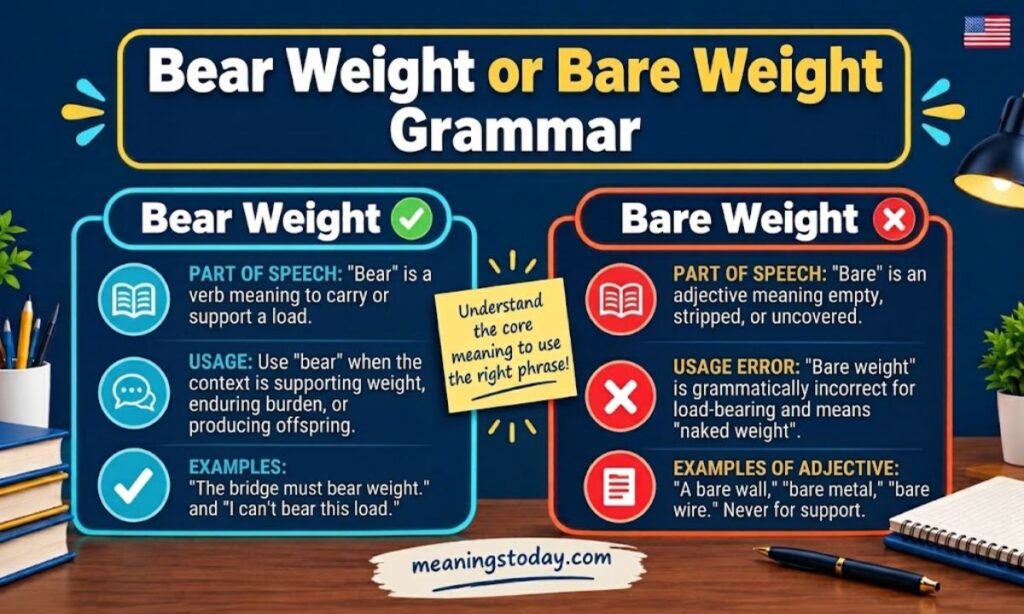
The grammar is easy. “Bear” is an irregular verb. Learn its forms in steps.
- Base form: bear
- Past: bore
- Past participle: borne
- Present: The beam bears weight.
- Past: The beam bore the weight.
- Ongoing: The wall is bearing weight.
- Before a noun: weight bearing (use a hyphen).
Example: “That is a weight bearing wall.” Do not remove it.
Note: “bare” was once an old past form of “bear,” but it is archaic today. Use “bore.”
Bare Weight vs Bear Weight Synonyms
Synonyms help you test Bear Weight vs Bare Weight. Try this method.
- Replace the word with a synonym.
- Read the sentence again.
- If it still makes sense, your word is right.
Bear: carry, support, hold up, withstand, endure
Bare: naked, uncovered, exposed, empty, minimal
Example: “The roof can support weight.” It works, so “bear” is right.
Wrong example: “The roof can uncover weight.” It makes no sense, so “bare” is wrong.
Bare Weight vs Bear Weight on Foot
“Bear weight” is very common in foot and leg care. Doctors use it to say how much load an injured limb can take. StatPearls (NCBI) describes these common grades.
- NWB (non weight bearing): no weight on the foot at all.
- TTWB (toe touch): toes touch the floor for balance only.
- PWB (partial): a set, small amount of weight is allowed.
- WBAT (as tolerated): you may put as much weight as feels comfortable, up to full weight.
- FWB (full): normal walking.
Example: After an ankle fracture, a doctor writes “non weight bearing for 6 weeks.” You must not stand on that foot.
- Pro: guided loading can support healing.
- Con: too much load too soon can harm the repair.
Always follow your doctor’s plan. This is general information, not medical advice.
Bare Weight vs Bear Weight in the UK

Is Bear Weight vs Bare Weight different in the UK? No. The rule is the same in US and UK English. Check it in steps.
- Write “bear weight” or “weight-bearing.”
- Skip “bare weight” and “weight baring.”
- Keep slang out of formal writing.
- Both countries: “bear weight” is correct.
- UK slang: in casual British talk, “bare” can mean “a lot.” That is slang only.
Example: “The bridge can bear weight” is right in New York and London.
Frequently Asked Questions
Is it “bear weight” or “bare weight”?
It is “bear weight.” It means to carry or support a load.
Is it “weight bearing” or “weight baring”?
It is “weight bearing.” Use a hyphen before a noun.
Is it “bear with me” or “bare with me”?
It is “bear with me.” It means “be patient with me.”
Is it “bare minimum” or “bear minimum”?
It is “bare minimum.” It means the least amount needed.
Is it “bear in mind” or “bare in mind”?
It is “bear in mind.” It means to keep something in your thoughts.
What does non weight bearing mean?
It means no weight at all on a limb. Doctors use it to protect healing.
Is it “bear down” or “bare down”?
It is “bear down.” It means to push or press hard.
Final Thought
The answer to Bear Weight vs Bare Weight is simple: write “bear weight.” “Bear” carries a load, and “bare” means uncovered. Use “weight-bearing” for building and medical terms.
Remember the swap trick: if “carry weight” fits, “bear” is right. Check the sentence, pick the word and your writing stays clean. You will not mix them up again.