

IONK in text usually means “I don’t know.” Some people also use it to mean “I only now know,” which shows a sudden realization. It replaces a full sentence with one quick word.
IONK is casual internet slang. It shows up in texts, DMs, and comments. Gen Z uses it the most, and it keeps chats short, fast, and easy to type.
What Does “IONK” Stand For?
IONK mainly stands for “I don’t know.” It works like a shorter, more casual cousin of IDK.
- I = I
- O = only (or “on,” depending on context)
- N = now
- K = know
- In some threads, IONK stands for “I only now know.” This version means someone just found out something new.
- The short form is easy to type fast during a chat.
- It sounds close to how people actually say “I don’t know” out loud.
Context decides which meaning fits. Most of the time, IONK simply means the sender is unsure or has no answer.
How “IONK” Is Used in Everyday Texting
People drop IONK into casual chats, group texts, and social captions. It replaces a full sentence with one quick word.
- Used when someone asks a question with no clear answer.
- Used to admit confusion without sounding rude.
- Often written in lowercase: “ionk lol.”
- Common in fast back-and-forth chats where typing speed matters.
IONK rarely appears in formal writing. It stays inside casual, friend to friend conversation.
Example of “IONK”
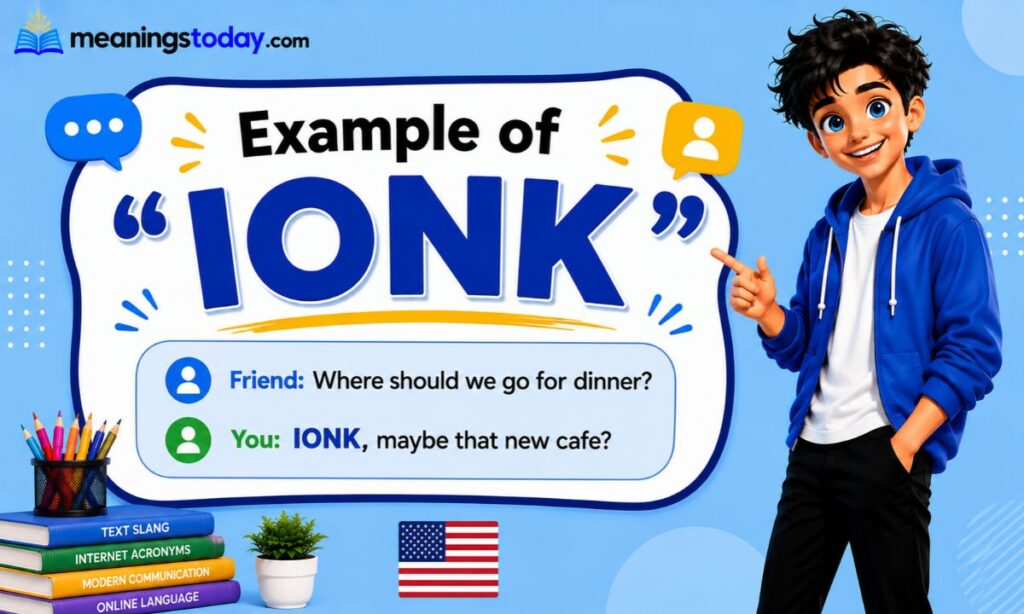
Seeing IONK in real messages makes the meaning click faster.
| Message | Meaning |
| “Where’s the party tonight?” → “ionk, ask Sam” | I don’t know |
| “Did the meeting get moved?” → “ionk, just heard now” | I only now know |
| “Why did she leave early?” → “ionk fr” | I genuinely don’t know |
A simple rule: if the answer feels uncertain, IONK fits.
The Origin of “IONK” and Its Popularity
IONK grew out of the same trend that gave us IDK, IDC, and TBH. Texting culture keeps shrinking full phrases into short letter codes.
- Short-form slang spread fast through SMS and early chat apps.
- Platforms like TikTok, Instagram, and Snapchat sped up how quickly new terms travel.
- IONK became more visible as younger users looked for a fresher alternative to IDK.
- It is not tied to one single viral post; it grew gradually across group chats and comment sections.
Its popularity keeps rising because texting favors short, phonetic-sounding words.
Other Ways to Say IONK
Several phrases carry the same meaning as IONK in casual chats.
- IDK I don’t know
- NC no clue
- Beats me casual, spoken-style reply
- Not sure plain, neutral phrasing
- IONO I don’t know (another texting variant)
Each option fits slightly different tones, from playful to plain.
Common Variations of “IONK” You Should Know
IONK shows up in a few written forms across different apps.
- ionk lowercase, most common in chats
- IONK capitalized, seen in comments or captions
- ionk fr “IONK for real,” adds emphasis
- ionk tbh combines two slang terms for stronger honesty
These variations don’t change the core meaning. They only shift the tone.
Why People Ask What Does IONK Mean in Text
Many readers search “what does IONK mean in text” because it looks unfamiliar at first glance.
- It’s not a standard dictionary word.
- It looks like a typo to anyone outside internet slang circles.
- Parents and older users often see it and pause mid-conversation.
- Search interest grows every time a new group of teens starts using it in group chats.
Understanding the term closes that generational gap quickly.
How IONK Fits Into Modern Digital Conversations
Texting rewards speed over grammar. IONK fits neatly into that shift.
- Character limits on some apps encourage shorter replies.
- Group chats move fast, so one-word answers keep pace.
- IONK blends into casual tone without sounding cold or distant.
- It works well next to emojis, showing feeling without extra words.
Short slang like IONK keeps conversations light and quick.
Why Younger Users Commonly Use IONK
Gen Z drives most of the current use of IONK.
- Younger users spend more time in fast scroll apps like TikTok and Snapchat.
- They value casual, phonetic slang over full sentences.
- Group chats among teens often use multiple shorthand terms in a single message.
- Trends spread through peer groups before adults even notice them.
Millennials tend to stick with IDK, while Gen Z leans toward newer variants like IONK.
IONK as a Reflection of Internet Language Trends
IONK shows how online language keeps evolving toward shorter, sound based slang.
- Internet slang often mimics spoken speech patterns.
- Terms spread across platforms within days, not years.
- New abbreviations replace older ones once they start to feel “overused.”
- IONK may fade or evolve again as new slang appears.
This pattern repeats with almost every generation of internet users.
The Emotional Meaning Behind Using IONK
IONK carries more tone than it looks like at first.
- It can sound playful, especially with “lol” or an emoji attached.
- It can sound genuinely unsure, without any sarcasm.
- It softens an answer, so the sender doesn’t sound dismissive.
- Tone usually depends on punctuation, capitalization, and the words around it.
Reading the full message, not just the word, gives the clearest sense of intent.
How IONK Improves Casual Online Communication
IONK helps chats move faster without losing meaning.
- It saves time compared to typing a full sentence.
- It keeps tone light in casual friend groups.
- It reduces pressure to give a perfect or detailed answer.
- It works across texting, DMs, and comment sections alike.
Short slang like this keeps digital conversations feeling natural, not robotic.
IONK Compared to Other Texting Shortcuts
IONK sits alongside other common texting shortcuts, though each has its own feel.
| Term | Meaning | Common Users |
| IDK | I don’t know | All age groups |
| IONK | I don’t know / I only now know | Mostly Gen Z |
| NC | No clue | Casual chats |
| TBH | To be honest | All age groups |
IONK feels newer and more casual than IDK, even though the core meaning overlaps.
Why Learning Slang Like IONK Matters Today
Knowing terms like IONK helps conversations flow without confusion.
- It closes the gap between different age groups online.
- It helps parents understand what kids are actually saying.
- It helps professionals decode casual messages from younger clients or coworkers.
- It keeps communication smooth across texting, social media, and workplace chats.
Digital slang changes fast, so staying current helps avoid awkward misunderstandings.
What Does Jank Mean
“Jank” is a separate slang term, unrelated to IONK, but often searched alongside it.
- Jank describes something low-quality, broken, or poorly made.
- Example: “This Wi-Fi connection is so jank today.”
- The adjective form, “janky,” is more common: “That charger cable looks janky.”
- It’s popular in gaming and tech communities to describe glitchy or unreliable things.
Unlike IONK, jank has nothing to do with uncertainty. It describes quality, not knowledge.
What Does Gonk Mean
“Gonk” is another unrelated slang term that people sometimes confuse with IONK because of the similar sound.
- In British slang, gonk commonly means a foolish or unintelligent person.
- It also refers to a classic furry novelty toy popular in the UK during the 1960s.
- Example: “Stop being such a gonk and just ask for help.”
- The word has no connection to texting shorthand or uncertainty.
Gonk and IONK only share a similar sound, not a similar meaning.
Ionk Meaning in Text From Girl
When a girl sends IONK in a text, the meaning stays the same as general usage, though tone often carries extra weight.
- It usually still means “I don’t know” or “I just found out.”
- Paired with a laughing emoji, it often signals a light, joking tone.
- Sent alone with no punctuation, it can signal genuine uncertainty or hesitation.
- Context from earlier messages in the same conversation gives the clearest read.
There’s no separate “girl version” of the meaning. Tone shifts with the full conversation, not the sender’s gender.
Frequently Asked Questions
What does IONK mean from a guy?
It means the same as usual: “I don’t know” or “I only now know.” Meaning doesn’t change by gender.
Is IONK the same as IDK?
Mostly yes. Both mean “I don’t know,” though IONK sometimes adds a sense of just now realizing something.
Is IONK an offensive word?
No. IONK is neutral slang. It simply expresses uncertainty or a new realization.
Where did IONK come from?
It grew out of general texting slang trends, similar to how IDK and TBH became popular.
Can IONK be used in formal writing?
No. IONK stays casual and belongs in texts, DMs, and social captions, not formal emails or documents.
Do older generations use IONK?
Rarely. IONK is mostly used by Gen Z, while older users tend to stick with IDK.
Does IONK mean the same thing on every app?
Yes, the core meaning stays consistent across texting, Instagram, Snapchat, and TikTok.
Conclusion
IONK simply means “I don’t know,” or sometimes “I only now know” when someone just learned something new. It’s casual internet slang, most common among Gen Z. It fits naturally into fast texting and social media chats.
Knowing what IONK means helps close the gap between generations. Next time someone sends IONK, you’ll know exactly what they mean. It’s either a quick “I don’t know” or a sudden realization.