
OD Mean — that’s the exact phrase most people type into Google the moment they see this word and draw a blank. And fair enough, because the term shows up everywhere: in texts, in comment sections, on medical charts, even on pipe specs at the hardware store. You’ve probably typed it yourself without stopping to think about what it actually means.
The short answer: this two-letter term mostly means “overdramatic” or “extremely” in modern slang, but it also carries serious meanings in medicine and formal writing. The exact translation depends entirely on where you come across it.
This guide breaks down every common meaning — from casual texting slang to medical terminology — so you never misread the room again. Whether a friend texted it to you, you saw it trending on TikTok, or you spotted it on a medical chart, you’ll walk away knowing exactly what’s meant.
Quick Summary of the Different Meanings
- Overdramatic or extra (Gen Z slang)
- Very / extremely (“that’s OD good”)
- Overdose (medical/emergency context)
- Officer of the Day (military)
- Overdrive (music/gaming)
- OD chill (relaxed vibe)
- Outside Diameter (engineering/measurement)
Each of these definitions is common, and none of them is “wrong.” The trick is figuring out which one applies to the conversation in front of you — and that’s exactly what this article walks through, section by section.
What Does OD Mean? – Quick Meaning
At its core, this word is a short way of saying something is happening at an extreme level. In texting and on social media, it usually replaces words like “very,” “too much,” or “excessively.”
Example: “You’re being OD right now” translates to “you’re being way too dramatic right now.”
It works almost like a volume knob for language. Instead of piling on extra adjectives, people drop this one short word in front of whatever they’re describing, and the intensity instantly comes through.
But context changes everything. In a hospital chart, the same two letters mean something completely different — and far more serious. That’s why understanding the meaning by context matters more than memorizing a single definition. A word that sounds harmless in a group chat can carry real weight in a clinical setting, so it pays to slow down and notice where you’re reading or hearing it.
Origin and Background
The slang version traces back to African American Vernacular English (AAVE), where it was used to describe something taken to an extreme — good or bad. Rappers and artists popularized the phrase in lyrics and interviews long before it ever showed up in a mainstream text thread.
Over the last decade, it spread through hip-hop culture, group chats, and eventually TikTok and Instagram comment sections, where it picked up speed among younger users who wanted a quick, punchy way to add emphasis. It eventually crossed over into everyday conversation among people who had no idea it started as regional slang.
The medical use is much older. It comes from a Latin-based abbreviation tied to “overdose,” and it has been standard medical shorthand for over a century, long predating the internet slang version entirely.
Interestingly, both meanings share a common thread: intensity. Whether it shows up in a text message or a medical chart, the term always signals that something has crossed a normal limit — the difference is simply how serious that “something” happens to be.
Real-Life Conversations: How People Actually Use It
Here’s how the word shows up in everyday texting and speech:
- “This pizza is OD good, bro.”
- “She’s OD mad at me for no reason.”
- “That test was OD hard.”
- “Stop being OD, it’s not that deep.”
- “He’s OD loyal to his friends.”
- “My commute today was OD long.”
- “Even my playlist felt OD repetitive by the end of the week.”
- “That movie ending was OD sad.”
- “This traffic today is OD annoying.”
In each case, the word works as an intensifier. You can usually swap it out for “really,” “extremely,” or “way too” without losing the meaning of the sentence.
What makes it stick in casual speech is how flexible it is. It fits in front of almost any adjective — good, bad, happy, tired, expensive — which is part of why it spread so fast across group chats and comment sections nationwide.
Emotional and Psychological Meaning
Beyond simple slang, this word often carries an emotional undertone. People use it to describe behavior that feels excessive, intense, or hard to ignore — the kind of moment where “a lot” doesn’t quite capture it.
Calling someone “OD” can point to:
- Overreacting emotionally — crying, yelling, or panicking over something small
- Being overly attached — texting too much, needing constant reassurance
- Excessive enthusiasm — being “extra” in a fun, harmless way
- Overthinking — spiraling on a small issue
The tone — friendly teasing versus genuine criticism — usually decides whether the comment feels playful or pointed. That’s why reading the full sentence, not just the single word, matters so much in these conversations.
A text like “lol you’re OD 😂” reads completely differently from “you’re being OD, seriously stop.” Same word, very different emotional weight — and that gap is exactly why context clues like emojis, punctuation, and tone of voice matter as much as the word itself.
Usage in Different Contexts
This term doesn’t mean the same thing everywhere, and mixing up contexts is where most confusion starts. Here’s a breakdown of how the meaning shifts depending on setting.
| Context | Meaning of OD | Example |
| Texting/Slang | Extremely / too much | “That’s so funny” |
| Medical | Overdose | “Patient came in for an OD” |
| Military | Officer of the Day | “Report to the officer on duty” |
| Gaming/Music | Overdrive | “Hit the overdrive pedal” |
| Engineering | Outside Diameter | “Pipe diameter is 2 inches” |
| Statistics | Overdispersion | Used in data modeling |
| Workplace | Overdelivering (informal) | “He’s OD with the reports” |
When NOT to Use It
The slang version is casual — great for friends, group chats, and social media. But there are places it simply doesn’t belong, and using it there can send the wrong signal entirely.
Avoid using this slang in:
- Formal emails or business communication
- Job interviews or professional meetings
- Academic writing or essays
- Conversations involving real medical emergencies (this can cause dangerous confusion)
- Messages to someone unfamiliar with the slang term
Using this slang in the wrong setting can come across as unprofessional or, worse, confusing if someone thinks you’re referencing an actual overdose. When in doubt, especially in writing where tone is hard to read, it’s safer to spell out what you actually mean.
Common Misunderstandings
A lot of confusion around this word comes from context collapse — using slang and formal English in the same space without realizing it.
Here are the most common mix-ups people run into:
- Thinking it always means overdose. It usually doesn’t in texting or on social media — that reading is almost always medical.
- Assuming it’s always negative. It’s often used positively, like in “OD talented” or “OD proud of you.”
- Believing this is brand-new slang. It’s been used in Black communities for decades before it went mainstream through music and social platforms.
- Confusing it with “extra.” The two are similar but not identical — “extra” leans toward showy, attention-grabbing behavior, while this term leans toward raw intensity in general, good or bad.
- Reading it the same way in every message. Punctuation, emojis, and who’s sending it all change how the word should be interpreted.
Variations and Types of OD (10 Examples)
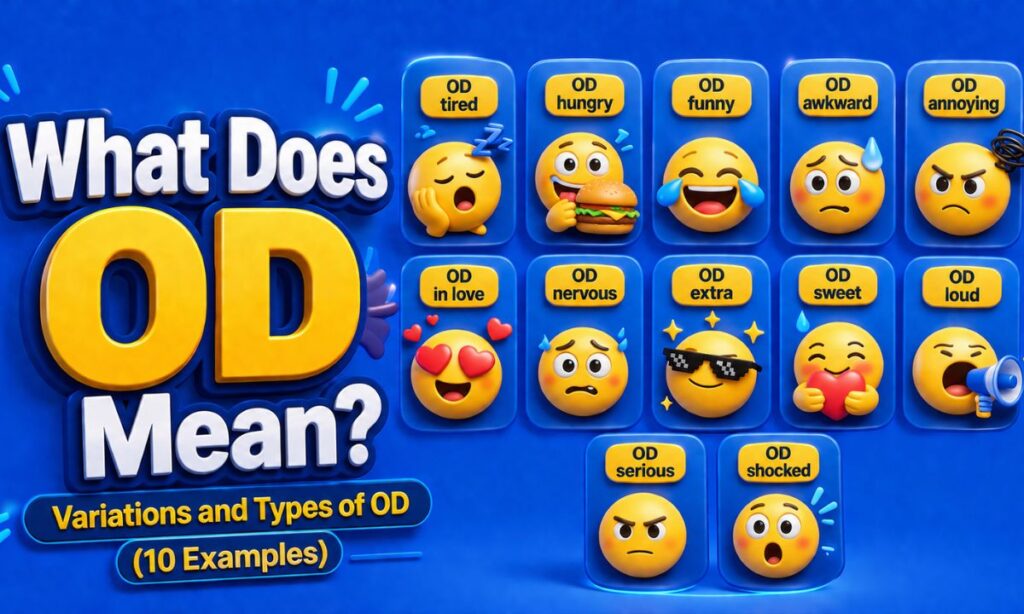
Different phrases build on this same base word. Here are common variations you’ll see in real conversations, along with what each one actually communicates:
- OD tired – extremely exhausted
- OD hungry – very hungry
- OD funny – hilariously funny
- OD awkward – painfully uncomfortable
- OD annoying – irritating beyond normal
- OD in love – deeply attached
- OD nervous – highly anxious
- OD extra – over-the-top behavior
- OD sweet – unusually kind
- OD loud – excessively noisy
- OD serious – no exaggeration, dead serious
- OD shocked – completely caught off guard
Each version keeps the same rule: the word boosts the intensity of whatever comes after it. Once you spot the pattern, you can decode almost any new combination you come across, even ones not listed here.
How to Respond When Someone Uses It
If someone calls you this in a text or in person, don’t panic — context usually makes the tone clear pretty quickly.
A few natural responses to have ready:
- Laugh it off if it’s playful: “Yeah, I know, I’m dramatic lol.”
- Ask for clarity if it feels harsh: “What do you mean by that?”
- Own it if it’s true: “Guilty. I was being a lot today.”
- Redirect the conversation if it’s clearly just banter: “Me? Nah, you’re the dramatic one.”
- Or simply admit it: “Honestly, I was being OD extra just then.”
If you’re unsure whether it’s a compliment or a jab, the safest move is simply asking what the person meant. Slang tone doesn’t always translate cleanly through text, and a quick follow-up question avoids unnecessary misunderstandings.
Regional and Cultural Usage
This slang is especially common across the US, particularly in urban communities in New York Atlanta, and other cities where AAVE has heavily influenced mainstream youth culture for years. From there, it moved outward into suburban and rural group chats through music, memes, and celebrity usage.
It’s also widely used across the UK, though British slang sometimes blends it with local expressions like “peak” or “mad,” so the exact flavor of the phrase can shift slightly by region.
On TikTok and Instagram, it has become nearly universal among Gen Z, regardless of location, thanks to viral audio trends and comment culture that spread faster than any single city or community.
Is It Safe for Kids?
The slang meaning is generally harmless — it’s the texting equivalent of saying “so” or “really.” Kids and teens use it constantly without any connection to drugs or overdose whatsoever.
That said, parents should still keep an eye on a few things:
- Confusing this slang with real medical overdose warnings, which can matter in an emergency
- Kids using the word to downplay genuinely concerning behavior, like repeated “I was so sad” messages dressed up in slang that hint at something bigger
- Situations where the slang overlaps with jokes about self-harm — this always deserves a real conversation, not a quick dismissal
Most of the time, though, it’s simply casual teen language with zero harmful intent, and treating it as such helps keep communication open rather than making kids feel policed for normal slang use.
OD Meaning: Measurement
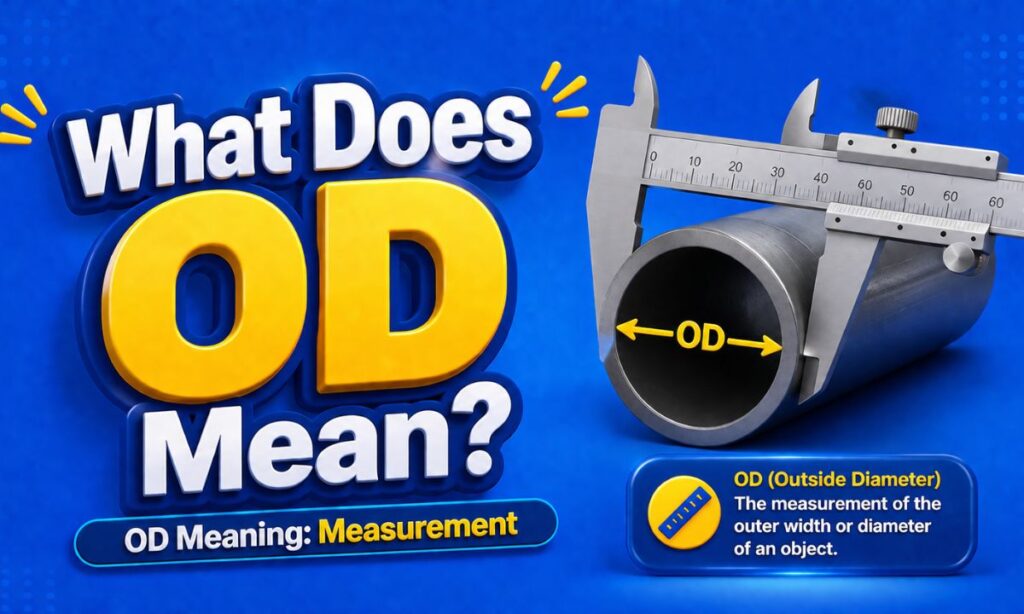
In technical and engineering fields, these letters stand for Outside Diameter. It measures the exterior width of a round object like a pipe, tube, or cylinder — as opposed to ID (Inside Diameter), which measures the interior width instead.
This is standard terminology in manufacturing, plumbing, and construction specs, and it shows up constantly on parts catalogs, blueprints, and hardware store labels. If you’re ordering pipe fittings or shopping for tubing, knowing this distinction can save you from buying the wrong size entirely.
OD Meaning: Medical
In healthcare, this abbreviation carries two important meanings:
- Overdose — taking too much of a drug or substance, which can be life-threatening and requires immediate medical attention
- Oculus Dexter — Latin for “right eye,” used in prescriptions and eye exams to indicate which eye a measurement or instruction applies to
This medical shorthand is never used casually in clinical settings. If you ever see it on a prescription, a hospital chart, or hear it in a health-related conversation, treat it seriously and check the surrounding context immediately. Mistaking one meaning for the other in a medical setting could genuinely cause confusion during treatment.
OD Meaning: Slang on TikTok
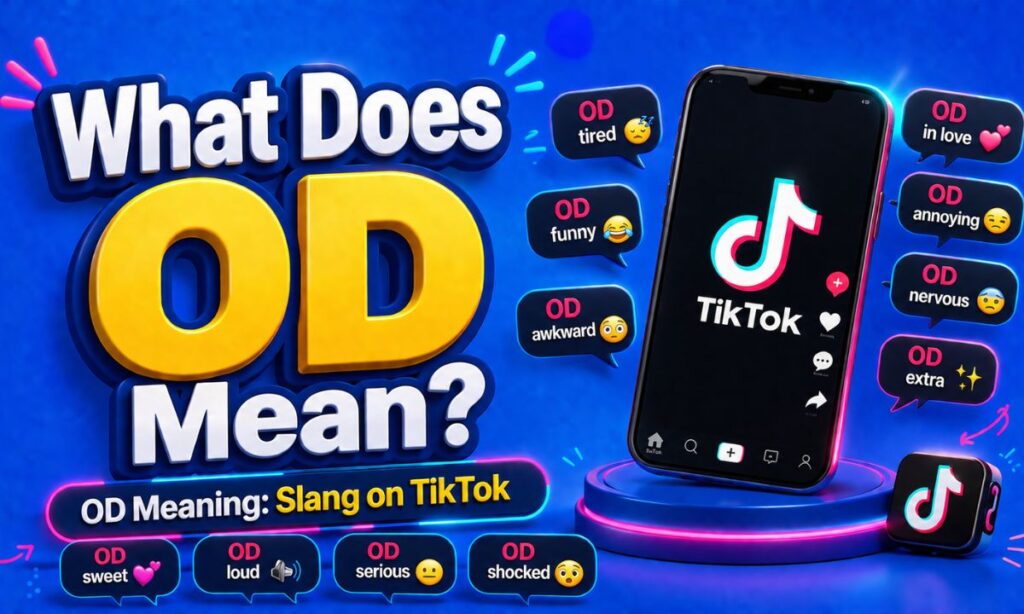
On TikTok, this word is one of the most-used intensifiers in captions and comment sections. It shows up in trends, reaction videos, duets, and comment threads constantly, often stacked with other slang for extra effect.
Typical TikTok usage looks like:
- “This trend is OD overrated 💀”
- “Bro said the funniest thing, I’m OD dead”
- “That fit is OD clean”
- “This edit is OD smooth”
- “This sound is OD addictive, I can’t stop”
It functions almost exactly like “literally” or “so” — a filler word that boosts emotional emphasis without adding much literal meaning on its own. Part of its popularity on the app comes from how well it fits short captions, where every character counts and a two-letter word does a lot of work.
OD Meaning in Work
In a professional or workplace setting, these two letters can mean a few different things depending on the industry you’re in:
- Organizational Development — an HR term for improving company structure, culture, and processes over time
- On Duty — used in scheduling, shift work, and staffing rosters
- Overdelivering — informal shorthand for going above and beyond on a project or deadline
Avoid using the casual slang version in professional emails or Slack messages to leadership — stick to plain, clear language in work communication, and save the slang for after-hours chats with coworkers you’re close with.
Frequently Asked Questions (FAQs)
Does OD always mean overdose?
No. In texting and slang, this word almost always means “extremely” or “very.” Overdose is the medical meaning, used only in healthcare contexts.
Is OD positive or negative?
It can be either. “OD talented” is a compliment, while “OD annoying” is a criticism. The word itself is neutral — tone decides which way it lands.
Can I use OD at work?
It’s best to avoid this slang in formal emails or meetings. Save it for casual conversations with friends or on social media instead.
Why do people say OD instead of very?
It’s shorter, more expressive, and carries cultural weight from AAVE and hip-hop culture. It feels more casual and relatable than plain old “very.”
Is OD used the same way everywhere?
No — the meaning of OD shifts depending on the setting you’re in.
Is OD rude?
Not usually. It’s a normal slang intensifier, similar to “so” or “literally.” Whether it feels rude depends on the sentence, not the word alone.
Is OD Gen Z slang?
It’s popular with Gen Z today, but it originated earlier in Black American communities. Gen Z helped push it into mainstream texting and social platforms.
Can OD be dangerous to joke about?
Yes, in specific contexts. Joking with this word near real overdose or self-harm topics can be harmful or confusing. Always read the room first.
Does OD mean the same thing in every state?
Mostly yes, since OD spread nationally through music and social media rather than staying regional.
What does OD mean in a text message?
In texts, it almost always means “extremely” or “way too much” — used to add emphasis, like “OD tired” or “OD funny.”
Conclusion:
So, what does OD mean? It depends entirely on where you find it. In texting and social media, it’s simply an intensifier — a casual way to say “very” or “extremely.” In medicine, it can mean something far more serious, like an overdose. And in fields like engineering or the military, it takes on entirely different technical meanings.
The key takeaway: always read this word in context. Once you understand the setting — texting, medical, workplace, or technical — the meaning becomes obvious almost instantly. Now that you know every major use of the term, you’ll never misread it again, no matter where it shows up.