

STTM mean in slang usually points to one thing: “Stop Talking To Me.” You saw “sttm” pop up in a text and froze for a second, and that single word can change the whole tone of a chat.If you’re asking what does STTM mean in slang, you’re not alone.
It’s one of those short forms that looks harmless but carries real weight depending on who sends it.
In most modern texting circles, STTM mean in slang points to a blunt, sharp reaction — something used to shut a conversation down, sometimes seriously, sometimes as a joke. The STTM meaning in slang shifts fast depending on who’s typing it.
STTM Meaning in Text
STTM meaning in text most commonly stands for “Stop Talking To Me.” People drop it when a chat feels annoying, repetitive, or just done.It’s short, sharp, and saves the sender from typing a full sentence. That’s the whole appeal of texting slang like this.
Context decides everything here. A friend sending “sttm 😭” after a silly joke reads completely differently than the same word sent cold, with no emoji at all.Because STTM meaning in text depends so heavily on tone, reading the full conversation matters more than the abbreviation itself.
STTM Meaning Slang Explained
As slang, STTM works as a quick dismissal — a way to say “enough” without sounding too harsh. It’s part of a wider trend of short, blunt texting phrases.STTM meaning slang explained simply: someone wants the topic dropped, or wants space from the conversation for a moment.
It’s not a formal phrase and has no single dictionary entry. Its meaning shifts based on age group, platform, and relationship between the people texting.That flexibility is exactly why so many people search for it — the same three letters can be a joke one day and a real boundary the next.
What Does STTM Mean in Chat?
In live chats — Discord, group texts, gaming lobbies — STTM usually keeps its core meaning: “stop talking to me,” used to end a thread fast.Fast-paced chats reward short slang. Nobody wants to type a full sentence mid-conversation, so STTM does the job in four letters.
What does STTM mean in chat often comes down to pacing. If the chat is fast and casual, it reads as playful. If it follows a tense exchange, it reads as final.Watching for punctuation helps too. “sttm lol” softens it, while “STTM.” with a period can feel like the last word in an argument.
STTM Meaning on Snapchat
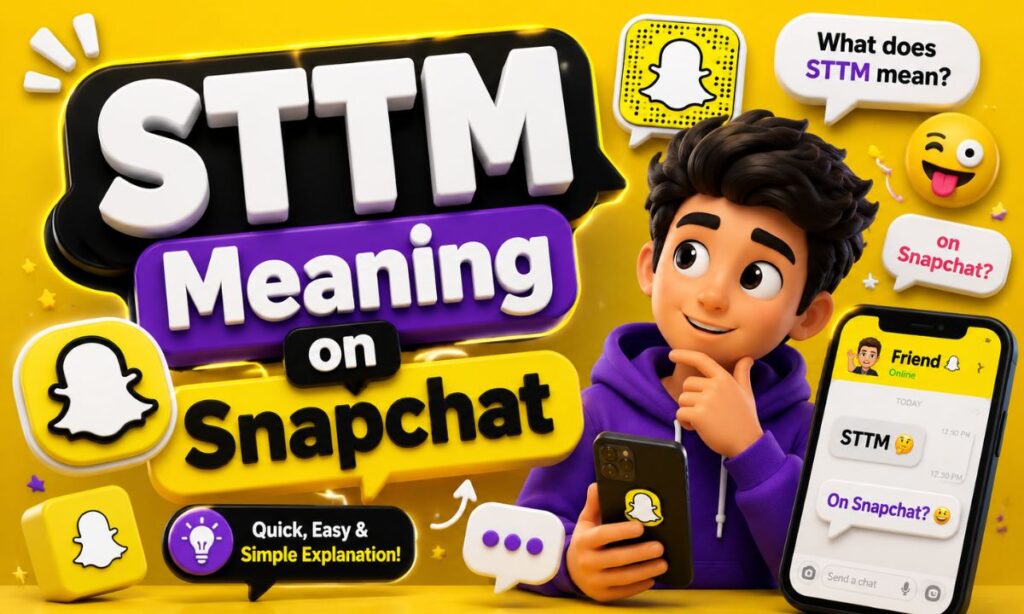
STTM meaning on Snapchat rarely changes from its texting root — it’s still “Stop Talking To Me,” often sent after a long streak of back-and-forth snaps.Snapchat’s fast, disappearing format makes blunt slang like this common. Messages vanish quickly, so tone has to be read in the moment.
Because Snapchat conversations move quickly between friends, STTM here leans playful more often than not, especially with a laughing emoji attached.Still, without context, STTM meaning on Snapchat can come across as cold, so it’s worth checking the mood of the chat before replying with a joke.
This is one more case where STTM meaning in slang depends more on the friendship than the platform itself.
STTM Meaning on Instagram, TikTok & WhatsApp
Across Instagram DMs, TikTok comments, and WhatsApp chats, STTM keeps the same base meaning but shifts in intensity depending on the platform’s culture.On TikTok comments, it often appears as a reaction to an annoying take or a repeated joke in a thread, closer to “enough already.”
On WhatsApp, which skews toward more personal or family conversations, STTM tends to appear less often and, when it does, can carry more weight.Instagram sits in between — casual among friends, but easy to misread in comment sections full of strangers. Across all three apps, STTM mean in slang stays consistent even as the tone around it changes.
Funny Tone
In a funny tone, STTM works as comic exaggeration — a dramatic “stop talking to me” reaction to something ridiculous a friend just said.Think of it like an eye-roll in text form. Nobody actually wants the conversation to end.
Paired with laughing emojis or all lowercase letters, this version reads instantly as a joke rather than a real request for silence.The humor comes from overreacting on purpose, which is a huge part of how Gen Z slang works in general. In this version, STTM meaning slang explained through comedy is really the whole point.
Sarcastic Tone
Sarcastic STTM leans drier than the funny version — often typed in caps, with no emoji, right after a corny or over-the-top comment.It mimics annoyance without actual annoyance behind it. That gap between the words and the real feeling is what makes it sarcastic.
Readers usually catch this tone through timing: a sarcastic STTM shows up right after a punchline, not after several messages of buildup.Misreading sarcasm as real anger is one of the most common mix-ups with this slang term.
Romantic Tone
In flirty conversations, STTM can flip its usual meaning entirely, becoming a teasing “you’re making me blush, stop” rather than a real request to stop.It often follows a compliment or a bold flirty line, working almost like a shy reaction dressed up as annoyance.
This romantic use relies heavily on existing chemistry between two people — it rarely lands the same way between strangers.Emojis like 🙈 or 😳 next to STTM are strong signals that the sender means it playfully, not seriously.
Angry Tone
An angry STTM is the most literal version — a direct, serious request to stop messaging, usually after real frustration has built up.There’s no emoji softening it here. Often it’s typed in full caps or followed by silence, which signals the sender means exactly what they said.
This tone shows up after arguments, repeated unwanted messages, or when someone feels disrespected in the conversation.Responding to this version with a joke usually makes things worse, since the sender isn’t looking for banter. Here, STTM mean in slang is as literal as the term ever gets.
Playful Tone
Playful STTM sits close to the funny tone but leans lighter — used between close friends who tease each other constantly throughout the day.It often appears mid-conversation, not as an ending, which is a giveaway that the sender wants the chat to continue.
Group chats use this version constantly, especially when one person keeps making the same joke over and over.Because playful STTM is so common among close friend groups, it rarely needs an emoji to soften it — the relationship does that work already.
Part of Speech
Grammatically, STTM functions as an imperative phrase — a command, similar to “stop” or “quiet” — rather than a noun or adjective.It stands in for a full sentence, so it behaves more like a shorthand verb phrase than a single word category.
Because it’s slang and not standard grammar, it doesn’t follow traditional sentence rules and rarely gets modified with tenses or plurals.Its whole function is speed: replacing a full command with four letters.
Sentence Position
STTM almost always appears at the end of a message, working as a reaction to whatever came right before it.Occasionally it opens a message too, especially when someone is responding directly to a previous text with immediate annoyance or humor.
It’s rarely used mid-sentence, since its job is to react, not to build a longer thought.This end-of-message habit is common across most reaction-based texting slang, not just STTM.
Does It Replace a Full Sentence?
Yes — STTM stands in for a complete sentence, most often “you need to stop talking to me right now.”That’s the entire point of texting abbreviations like this one: fewer keystrokes, same message delivered.
Because it replaces a full sentence, tone carries extra weight. Without the missing words, punctuation and emojis do the heavy lifting.This is also why STTM can be misread — a full sentence gives more room for nuance than four letters can.
Tone Impact
Tone changes everything about how STTM lands, more than almost any other factor in the message.The exact same four letters can read as a joke, a flirt, or a real boundary, depending entirely on delivery.
Capitalization, punctuation, emojis, and prior messages all shape how the receiver interprets it in that moment.Because of this, guessing the tone from the word alone is risky — the surrounding conversation always tells the real story.
Formal vs Informal Use
STTM belongs firmly in informal texting and should stay out of professional or formal writing entirely.Using it in a work email or formal message risks sounding rude, unprofessional, or simply confusing to someone unfamiliar with slang. Anyone unsure of STTM meaning in slang should simply avoid it in formal writing altogether.
In casual settings — friend groups, social apps, gaming chats — it fits naturally and rarely causes issues.The general rule: if the conversation wouldn’t normally include emojis or slang, STTM doesn’t belong there either.
Funny Replies
A lighthearted STTM usually gets a funny reply back, keeping the joke going rather than ending the conversation.Something like continuing the “annoying” behavior on purpose, or replying with more laughing emojis, matches the playful energy.
These replies work best when the relationship is already casual and joking is a normal part of how you talk.The goal isn’t to actually stop — it’s to play along with the bit.
Serious Replies
When STTM arrives in a clearly angry or final tone, the safest reply is a short, respectful acknowledgment rather than a joke.Something simple, like giving space or asking calmly if everything is okay, works better than pushing the conversation further.
Ignoring the seriousness of this version can escalate tension instead of resolving it.Reading the tone correctly here matters more than crafting a clever comeback.
Flirty Replies
A romantic-tone STTM usually invites a teasing reply back, continuing the playful compliment rather than backing off.Replying with another light tease, or simply asking “why, too much?” keeps the flirty energy going.
This exchange works because both people already understand STTM isn’t literal in that context.Overthinking a flirty STTM usually kills the mood faster than any reply could.
Neutral Replies
Sometimes STTM shows up without strong emotion attached — just a quick, low-stakes reaction to something mildly repetitive.In these cases, a simple “lol okay” or a laughing emoji is enough to close the loop.
Neutral STTM doesn’t need analysis. It’s closer to a verbal shrug than a real statement.Matching low energy with low energy keeps these exchanges smooth and simple. Even here, STTM mean in slang stays low-stakes rather than dramatic.
Age Group
STTM is used mostly by teens and young adults who are active on Snapchat, TikTok, and group texting apps daily.Older users tend to encounter it less often and may need context clues to understand it at all.
Familiarity with STTM tends to correlate closely with how much time someone spends in fast-paced digital chat spaces.That said, plenty of adults pick it up quickly once they see it used a few times. Knowing STTM meaning in slang has become almost a small marker of how online someone is.
Gen Z vs Millennials
Gen Z tends to use STTM freely, often exaggerated for comedic effect across TikTok comments and group chats.Millennials, by comparison, use it less frequently and are more likely to type it out as a genuine request rather than a joke.
This generational gap shows up across most modern slang, not just this term — younger users lean toward irony and exaggeration.Understanding which generation you’re texting can help you judge whether STTM is playful or literal.
Regional Usage
STTM shows up most in English-speaking online spaces, particularly the United States, UK, Canada, and Australia.In non-native English-speaking regions, people sometimes adopt only the literal meaning, since sarcasm and tone shifts don’t always translate well through text.
Because slang spreads through social media rather than geography alone, usage can still appear anywhere with active TikTok or Snapchat communities. STTM mean in slang, in this sense, travels faster than geography usually allows.
Platforms Where STTM Is Popular
STTM is most common on Snapchat, TikTok comments, Discord, and group texting apps where fast, casual replies are the norm.
These platforms favor speed and reaction-based communication, which is exactly the niche this slang term fills.It appears far less often on formal platforms like LinkedIn or professional email threads, where the tone doesn’t match.
School
Among students, STTM is a common reaction to teasing, group chat spam, or repetitive jokes between classmates.It’s rarely meant literally in school settings — most of the time, it’s part of ongoing banter between friends.
Teachers and parents unfamiliar with the term might misread it as more serious or rude than intended.Understanding the school-age context helps explain why the term spreads so quickly among younger users. Classroom group chats are often where the STTM meaning in slang first clicks for a lot of students.
Office
STTM has almost no place in office or workplace messaging, even in casual internal chat tools like Slack.Using it with coworkers risks sounding unprofessional or even disrespectful, especially with senior colleagues.
If a work chat feels overwhelming, a polite, spelled-out message always works better than slang shorthand.Keeping slang like STTM Mean in Slang confined to personal chats protects your professional image.
Assuming It Is Always Rude
One common mistake is assuming STTM always signals anger or rudeness, when most uses are actually playful or joking.
Judging it without context — tone, emojis, relationship — leads to unnecessary misunderstandings between friends.
Most STTM messages come from casual, funny exchanges rather than genuine frustration.
Reading the full conversation before reacting avoids this common trap.
Using It With Strangers
Sending STTM to someone you barely know is risky, since they can’t read your tone the way a close friend could.Without shared context, it’s far more likely to come across as genuinely rude or dismissive.
It’s safer to save this slang for people who already understand your texting style and sense of humor.With strangers, a clearer, more spelled-out message avoids unnecessary awkwardness.
Sttm Meaning Slang Urban Dictionary
Urban Dictionary-style definitions for STTM vary widely, but “Stop Talking To Me” remains the most frequently cited meaning across slang sources.
Because crowd-sourced slang sites allow multiple submissions, alternate meanings sometimes appear alongside the primary one, adding to the confusion.Cross-checking a few different slang sources is the best way to confirm which meaning fits your specific conversation.
What Does Sttm Mean in Snapchat
On Snapchat specifically, STTM usually keeps its core meaning but leans more playful, especially during long-running streak conversations between friends.It often appears after a joke or exaggerated story, not as a genuine request to end the chat.
Snapchat’s casual, friend-heavy culture makes the lighter interpretation far more common than the angry one.Still, tone and emoji use remain the best clues for reading it correctly.
What Does STTM mean on TikTok
On TikTok, STTM frequently shows up in comment sections, reacting to funny videos, cringe content, or repeated jokes in a thread.It works almost like a comedic exaggeration — “I can’t handle this content” — rather than a literal request.
Because TikTok comments are public and fast-moving, this version rarely carries real anger behind it.Creators and viewers alike use it as quick shorthand for over-the-top reactions.
Confusing It With STFU
A frequent mix-up is treating STTM the same as STFU, but the two carry very different weight and intent.STFU is far more aggressive and vulgar, while STTM stays milder, even in its angriest form.
Confusing the two can make a playful message seem far more hostile than it was meant to be.Recognizing the difference helps avoid unnecessary conflict in casual conversations.
Frequently Asked Questions
What does STTM mean in text?
STTM in text most commonly means “Stop Talking To Me,” used to react to an annoying, repetitive, or overwhelming conversation. Its tone shifts from joking to serious depending on context.
What does STTM mean on Snapchat?
On Snapchat, STTM keeps the same core meaning but usually leans playful, especially between close friends during ongoing streaks.
Is STTM rude?
Not always. It can sound blunt out of context, but most uses among friends are playful rather than genuinely rude.
What does STTM mean on TikTok?
On TikTok, STTM usually appears in comments as an exaggerated, funny reaction rather than a literal request to stop.
Is STTM the same as IDK?
No. IDK means “I don’t know,” while STTM means “Stop Talking To Me” — the two serve completely different purposes.
Can adults use STTM?
Yes, though it’s used far more often by teens and young adults active on texting apps and social media.
How do you respond to STTM?
Match the tone it was sent in — a joke deserves a joke back, while a serious STTM deserves space and a calm reply.
Is STTM formal slang?
No. STTM is strictly informal and should be avoided in professional or formal writing.
Does STTM mean the same thing in every group chat?
Not necessarily. Meaning shifts based on the group’s usual humor, so it’s worth watching how a specific chat uses it before assuming.
Can STTM be used as a joke between coworkers outside of work chats?
Yes, in casual, personal conversations with coworkers outside official channels, but it should stay out of professional messaging tools.
Conclusion
At its core, STTM mean in slang almost always traces back to “Stop Talking To Me” — a short, blunt phrase that shifts meaning entirely based on tone.
Across texting, Snapchat, TikTok, and group chats, the same four letters can be a joke between close friends or a genuine boundary after real frustration.
The safest approach is simple: read the conversation, not just the word. Emojis, punctuation, and the relationship between the two people texting tell you far more than STTM alone ever could.