


Unphased or unfazed? The correct spelling is unfazed. It means “not worried or disturbed.” Unphased is mostly a spelling mistake, because “faze” and “phase” sound the same.
This guide explains the unphased or unfazed difference step by step. You will see simple meanings, UK and US usage, and real examples. By the end, you will pick the right word every time.
Quick Answer (unfazed or unphased)
Follow these steps to get the answer in seconds.
- Ask yourself: “Do I mean calm and not bothered?”
- If yes, write unfazed.
- If you mean “not done in stages,” that is the rare unphased meaning.
Example: The pilot stayed unfazed during the bumpy landing.
- Unfazed = calm
- Unphased = usually a typo
- Rule to remember: not bothered = unfazed
Meaning and Definition of Each Word
Both words sound like “un-FAYZD.” Let’s break them down one by one.
1. Unfazed
Unfazed comes from the verb “faze,” which means to upset someone.
- Step 1: Take “faze” (to disturb).
- Step 2: Add “un-” (not).
- Step 3: You get unfazed (not disturbed).
Example: Mia was unfazed by the loud crowd.
2. Unphased
Unphased comes from “phase,” which means a stage.
- Step 1: Take “phase” (a stage).
- Step 2: Add “un-” (not in stages).
- Step 3: You get unphased (all at once).
Example: The school chose an unphased change, so every class switched on Monday.
Many people use unphased to mean “not bothered.” That use is not standard.
Unfazed Meaning
Unfazed meaning: not troubled by something stressful or surprising.
Here is how to use it.
- Spot a stressful event (a delay, bad news, criticism).
- Check if the person stayed calm.
- Write “unfazed by” plus the event.
Example: Tom was unfazed by the bad review.
- Origin: linked to the old word “feeze,” meaning to frighten
- First known use: the 1850s
- Tone: a little informal, but fine for blogs and news
Key Differences Between the Words
Compare the unphased or unfazed pair in four steps.
- Meaning: unfazed is about feelings. Unphased is about stages.
- Root: unfazed comes from “faze.” Unphased comes from “phase.”
- Dictionary status: unfazed is standard. Unphased is rare.
- Editor view: editors often change unphased to unfazed.
Example: The team was unfazed by the delay. (Feelings = unfazed.)
Real case: a news site once wrote “unphased by the solitude.” A reader asked for a fix to unfazed. Such corrections are very common.
Unphased or unfazed uk
Many writers wonder if British English accepts unphased. Let’s check it in steps.
Unphased or Unfazed (UK English)
- Open a UK dictionary.
- Look up “fazed” and “unfazed.”
- You will see the same spelling rule as in the US.
Example: The UK striker was unfazed by the big crowd.
UK English Usage Table
| Word | UK usage | Status |
| Unfazed | Common | Correct |
| Unphased | Rare | Usually seen as an error |
Simple Rule (UK English)
Write unfazed for “not bothered.” There is no UK and US spelling split here.
Comparison Table
Use this table in three quick steps.
- Find the meaning you need.
- Match it to a column.
- Copy the example.
| Feature | Unfazed | Unphased |
| Meaning | Not bothered | Not in stages (rare) |
| Root word | Faze | Phase |
| Status | Standard | Rare or nonstandard |
| Safe to use? | Yes | Usually no |
| Example | She was unfazed. | An unphased launch |
Unphased or unfazed examples
Here is how to test any unphased or unfazed sentence.
- Read the sentence out loud.
- Replace the word with “not bothered.”
- If it still makes sense, use unfazed.
Examples:
- He was unfazed by the hard exam. (Not bothered. Works.)
- The manager stayed unfazed in the crisis. (Works.)
✔ Simple Tip
If “not bothered” fits, the word is unfazed.
Examples in Sentences
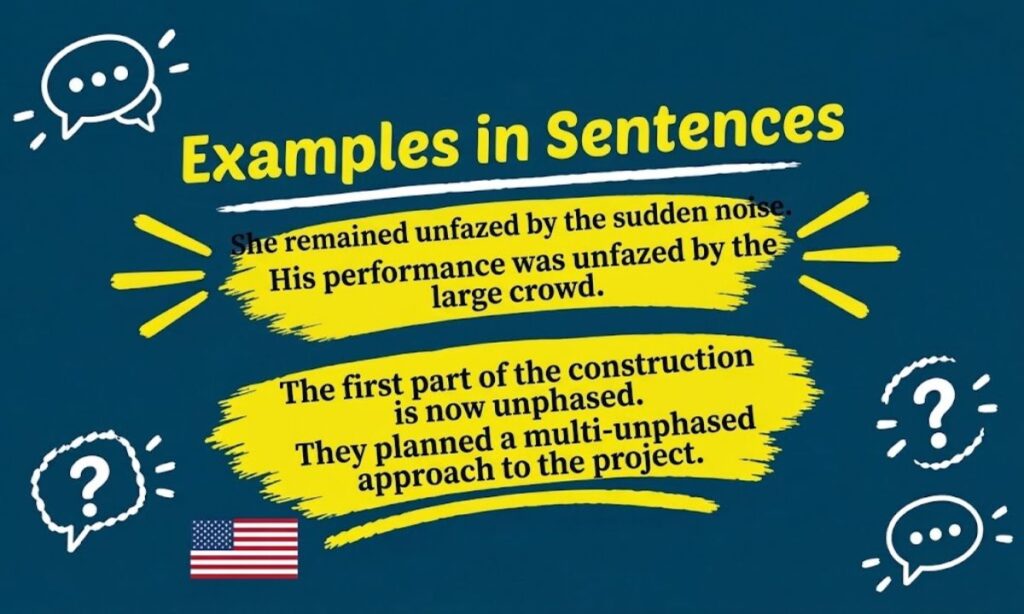
Learn from right and wrong sentences side by side.
Correct Use of “Unfazed”
- The kids were unfazed by the thunder.
- She walked in unfazed and gave her speech.
- The chef was unfazed by the dinner rush.
Incorrect Use of “Unphased”
- ✘ She was unphased by the news.
- ✔ She was unfazed by the news.
- ✘ He looked unphased by the crowd.
- ✔ He looked unfazed by the crowd.
Common Mistakes
Fix each mistake in steps.
1. Spelling Confusion
- Notice that “faze” and “phase” sound alike.
- Ask what you mean: fear or stage?
- Pick the matching spelling.
Example: Nothing can faze her. (fear = faze)
2. Confusing “Phase” and “Faze”
- Phase = a stage (the next phase of the project)
- Faze = to disturb (the noise did not faze him)
3. Incorrect Verb Usage
- Find the verb in your sentence.
- Ask if it means “disturb.”
- If yes, use “faze.”
- ✘ The noise did not phase me.
- ✔ The noise did not faze me.
Practical tip: search your draft for “phased” and check each one.
Tips to Remember the Difference
Use these tricks to remember unphased or unfazed.
Tip 1: Think of “Faze” = Fear
- Link “faze” with fear.
- Link “unfazed” with no fear.
Example: The cat was unfazed by the storm.
Tip 2: Ignore “Unphased”
- Forget unphased for daily writing.
- Use unfazed every time.
Tip 3: Use Real-Life Association
- Picture a calm person in a noisy place.
- Say, “She is unfazed.”
- Repeat it once. It will stick.
Unfazed or Unphased When to Use Each Word
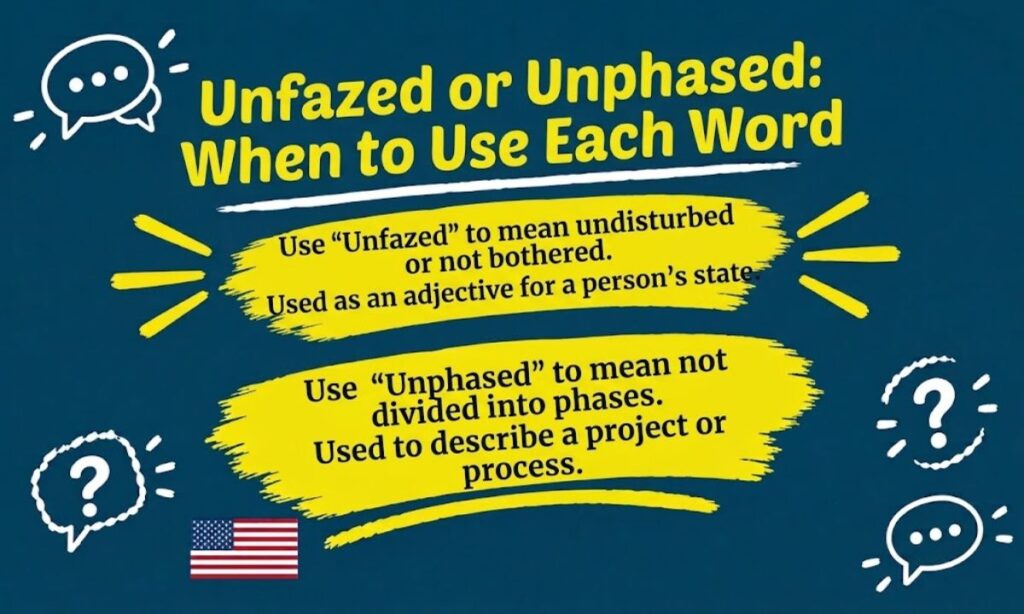
Follow this simple guide for unfazed or unphased choices.
Use “Unfazed” When:
- You mean calm or not worried.
- You write emails, blogs, or school work.
- You describe a reaction to stress.
Example: The nurse was unfazed by the busy shift.
Avoid Using “Unphased”
- It looks like a typo to many readers.
- Spellcheck tools may flag it.
- It can confuse your meaning.
Exception: “an unphased rollout” is possible in project talk. Even then, “all at once” is clearer.
Grammar Rules (If Applicable)
Grammar of unfazed is easy. Follow each rule.
1. “Unfazed” as an Adjective
- Find the person or group.
- Describe them with unfazed.
Example: The audience stayed unfazed.
2. “Faze” as a Verb
- Use “faze” for the action.
- It often appears in negative sentences.
Example: Nothing seems to faze her.
3. Negative Form
“Unfazed” already has “un-” in it. Do not add another “not.”
- ✘ He was not unfazed.
- ✔ He was unfazed.
Unphased or Unfazed Synonyms
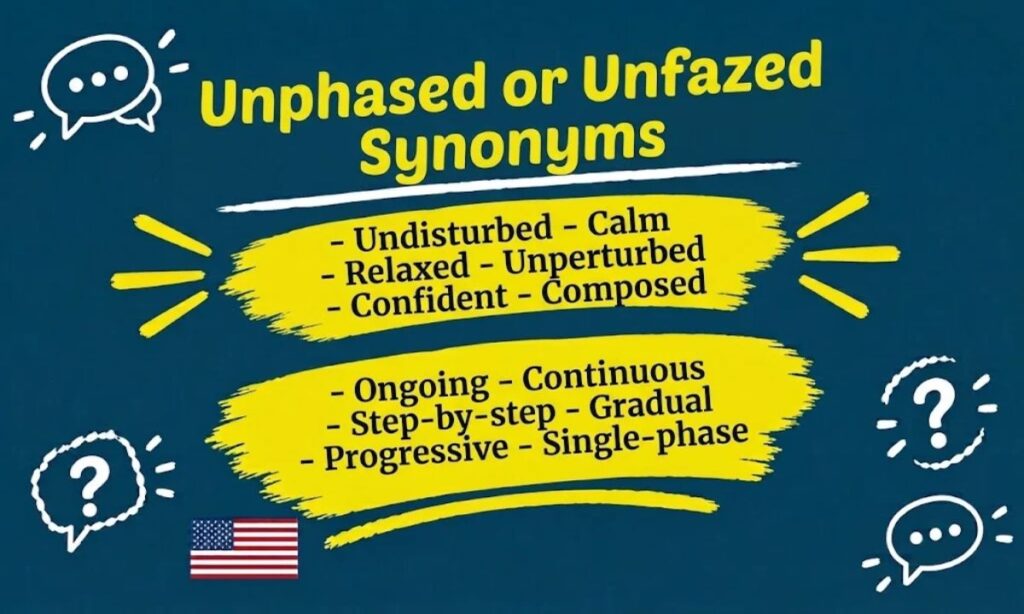
Need another word for unfazed? Use these steps.
✔ Simple Understanding
- Think “calm.”
- Pick a word with the same feeling.
- calm
- composed
- undaunted
- unbothered
- unruffled
Example: The captain stayed unruffled in the storm.
Quick Tip
Casual writing: “unbothered.” Formal writing: “composed.”
Synonyms or Related Words
| Word | Tone | Example |
| Undaunted | Formal | She was undaunted by the challenge. |
| Unruffled | Neutral | He stayed unruffled. |
| Nonchalant | Casual | She gave a nonchalant shrug. |
| Imperturbable | Very formal | An imperturbable judge |
Opposite word: fazed (bothered).
Frequently Asked Questions
Is “unphased” a real word?
Rarely. Most dictionaries call it a variant or a mistake. The standard word is unfazed.
Is it “unphased” or “unfazed”?
It is unfazed when you mean “not bothered.” That is the safe choice.
What does unfazed mean?
It means not worried, upset, or surprised by something.
What is the difference between faze and phase?
“Faze” means to disturb. “Phase” means a stage. They sound the same.
Is “unphased” correct in British English?
Not as a standard form. UK writers use unfazed too.
What is a synonym for unfazed?
Calm, composed, undaunted, and unruffled all work.
How do you pronounce unfazed?
It sounds like “un-FAYZD,” with stress on the second part.
Conclusion
The answer to unphased or unfazed is simple: unfazed is correct. It means calm and not bothered. Unphased is mostly a spelling slip, with only a rare “not in stages” meaning.
To remember it, link “faze” with fear and “phase” with stages. Read your sentence aloud and test it with “not bothered.” Then check your latest post today and fix any wrong unphased with unfazed.